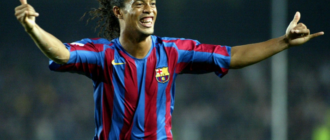
In a short but powerful statement, Ronaldinho summed up his connection with FC Barcelona by saying: “Barcelona is my home.” The Brazilian legend was featured in a video published by the club, where former players shared their reflections about their time at Barça. His response, though brief, captured the essence of his relationship with the team that defined his career.
2003/04: Ronaldinho joined Barcelona from Paris Saint-Germain for €30 million. The team was struggling in La Liga, but his arrival instantly lifted morale. His dazzling dribbles and decisive goals brought hope, even as Barça finished second behind Valencia. 2004/05: Under Frank Rijkaard, Ronaldinho inspired Barcelona to their first La Liga title since 1999. He scored 13 league goals and became the face of the team’s resurgence. 2005/06: The peak of Ronaldinho’s career. He won the Ballon d’Or, led Barcelona to a La Liga-Champions League double, and delivered iconic performances, including at Stamford Bridge against Chelsea and at the Santiago Bernabéu against Real Madrid.
2006/07: Though Barcelona did not win the league, Ronaldinho remained crucial, scoring 21 goals across competitions — his best tally at the club. 2007/08: Injuries and fitness issues limited his impact, and his time at the club came to an end. He departed in the summer of 2008, leaving a legacy that paved the way for Pep Guardiola’s golden era.When Ronaldinho arrived, Barcelona was in crisis. The club had gone four years without a league title, results were inconsistent, and their global reputation was fading. Ronaldinho changed everything. His first goals, often spectacular, restored excitement at Camp Nou. His charisma and artistry rekindled fan passion, drawing sell-out crowds.

His leadership on the pitch gave younger players confidence to express themselves. By the time Guardiola and Messi emerged as leaders of a new generation, Ronaldinho had already laid the foundations for a club philosophy rooted in attacking joy and creativity.One of Ronaldinho’s greatest contributions was his mentorship of Lionel Messi. In 2005, Ronaldinho assisted Messi’s very first goal for Barcelona against Albacete, embracing him afterwards in celebration. Messi later said that Ronaldinho’s support helped him integrate into the first team: Ronaldinho protected Messi in training sessions.
He encouraged him to play without fear. He gave him freedom to express his talent, just as he did. Beyond Messi, Ronaldinho’s influence extended to teammates like Deco, Eto’o, Xavi, and Iniesta. Many credit him with creating the environment that allowed them to blossom into legends themselves.When Ronaldinho describes Barcelona as “home,” it carries several layers of meaning: Personal Fulfillment: It was the club where he reached his peak, winning the Ballon d’Or and Champions League. Legacy: His magic remains embedded in the club’s DNA. He reintroduced joy, fun, and artistry at a time when Barça had lost its way. Connection With Fans: Even years after leaving, Ronaldinho receives standing ovations when visiting Camp Nou, reflecting the unbreakable bond he shares with the supporters.
While Barcelona’s history is filled with icons — Messi, Cruyff, Xavi, Iniesta — Ronaldinho’s role was unique: Cruyff laid the tactical philosophy. Messi delivered unprecedented dominance and numbers. Ronaldinho was the bridge between crisis and greatness, reviving belief and showing that artistry could win at the highest level. Without Ronaldinho’s impact from 2003–2006, it is doubtful that Barcelona would have been as attractive to stars like Messi, Eto’o, or even future signings. His influence extended far beyond statistics; it was cultural, emotional, and stylistic.
Ronaldinho’s words — “Barcelona is my home” — are more than a sentimental phrase. They reflect a truth shared by millions of fans who witnessed his era: that Barcelona gave him the platform to become a global superstar, and in return, he restored magic, joy, and global prestige to the club. With 207 matches, 94 goals, 70 assists, 2 La Liga titles, 1 Champions League, 2 Super Cups, and a Ballon d’Or, his record speaks for itself. But it is the memory of his smile, his tricks, and his ability to bring fans to their feet that defines his Barcelona legacy.